Incroci di dissolvenze incantate
Francesco Maggiore
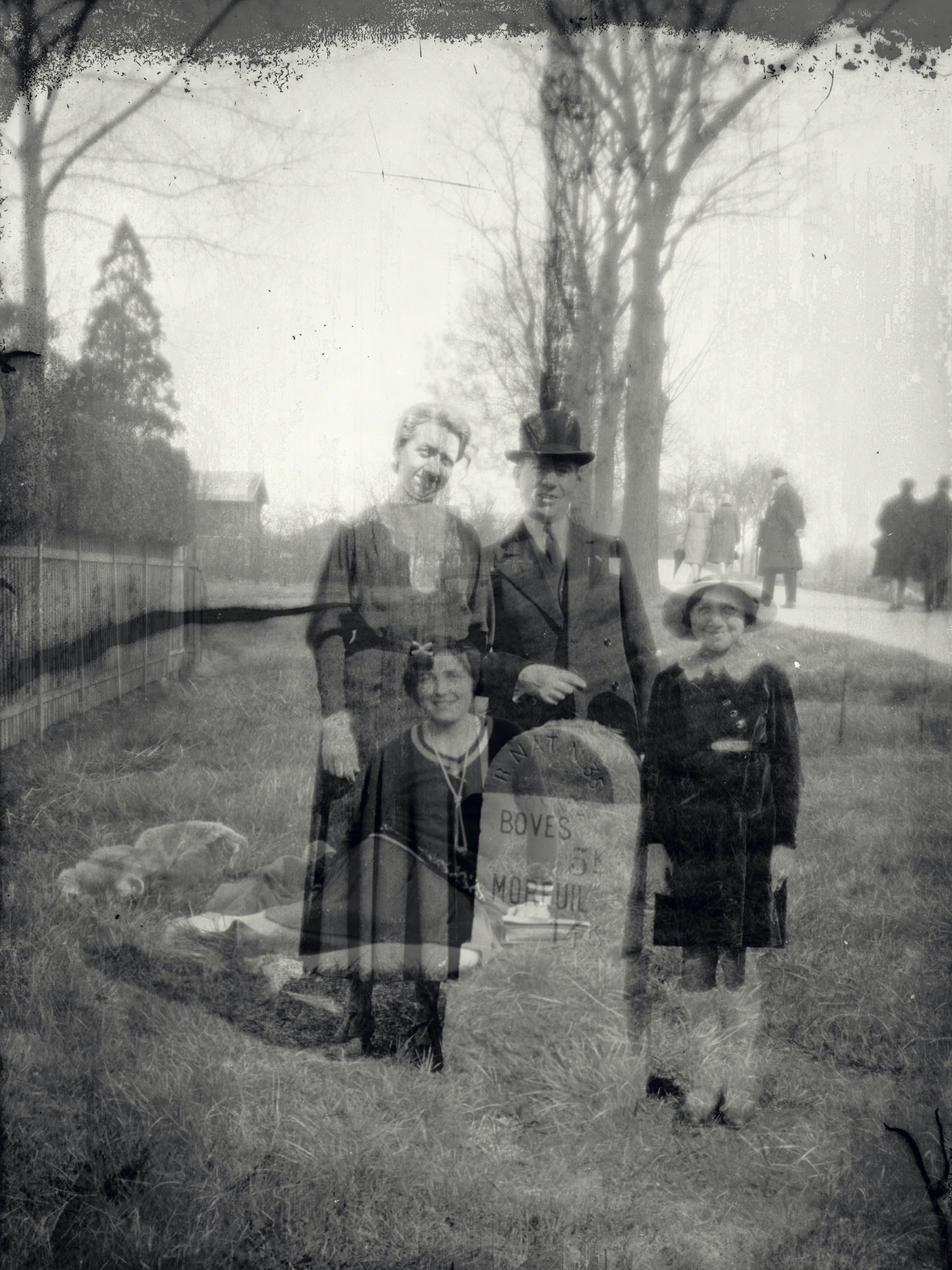
From the darkness of a drawer, seventy-five glass plates (9×12 cm) resurface, fragile and luminous, dating from the 1920s and 1930s. These are finds discovered by chance by the artist Ninni Pepe, very probably traceable to the French studio of the Caron family, and in particular to the photographer Raphaël Caron (1884–?), as suggested by a stamp on a photograph found in the same context. A further clue, which emerged from the analysis of one of the negatives (the inscription Amiens on a milestone), not only confirms their French origin but also recalls the very origin of photography, which, as is well known, found its first historical and cultural legitimacy in France: in 1826, with Nicéphore Niépce’s View from the Window at Le Gras, and in 1839, when Louis Daguerre made the daguerreotype process public in Paris, delivering photography to the technical and artistic domain of modernity. A genealogy that bears witness to a twofold matrix: on the one hand the technical dimension, on the other the cultural vocation. This ambivalence has marked the entire historical development of photography, constantly suspended between document and invention, between art and science.
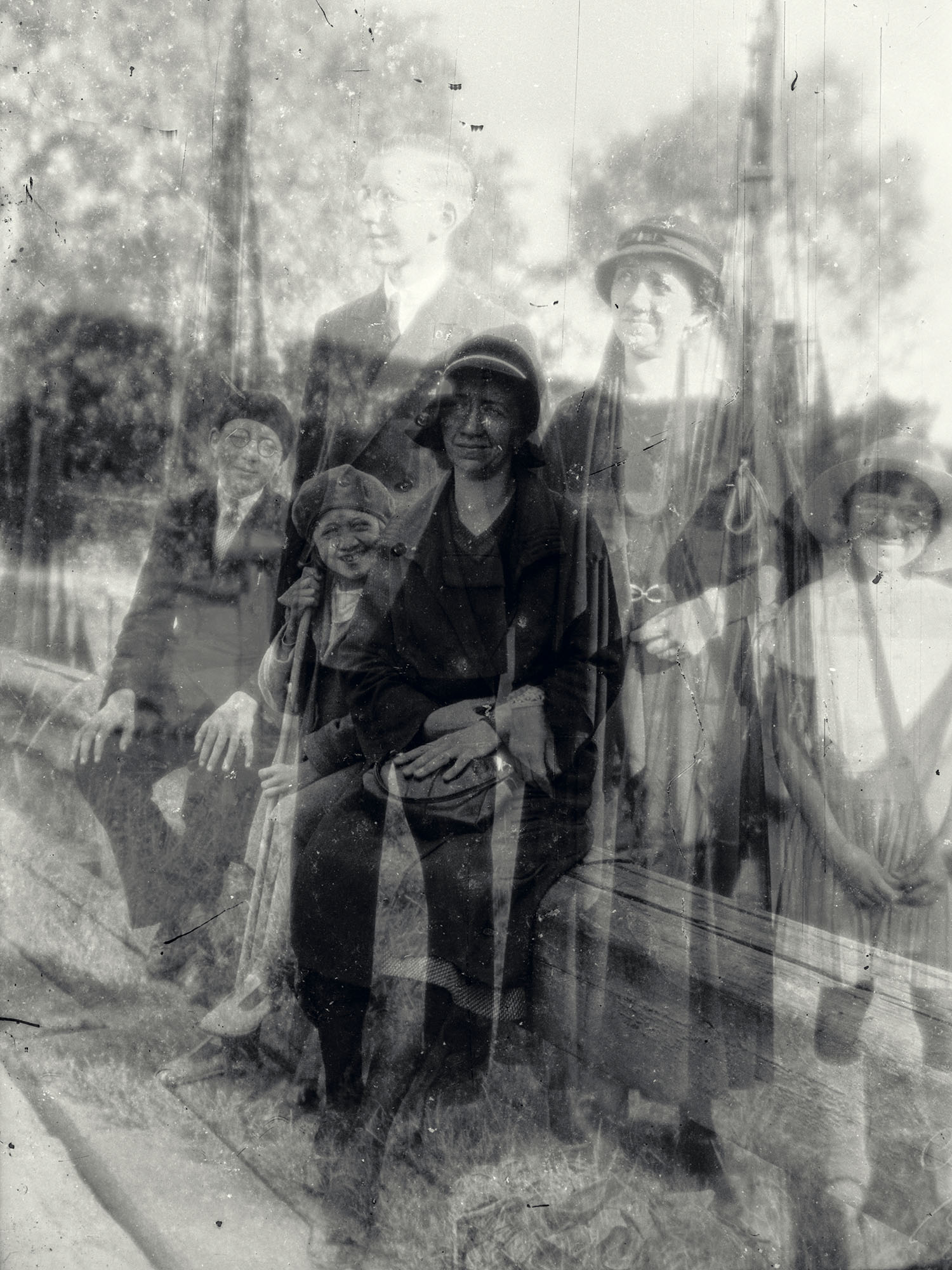
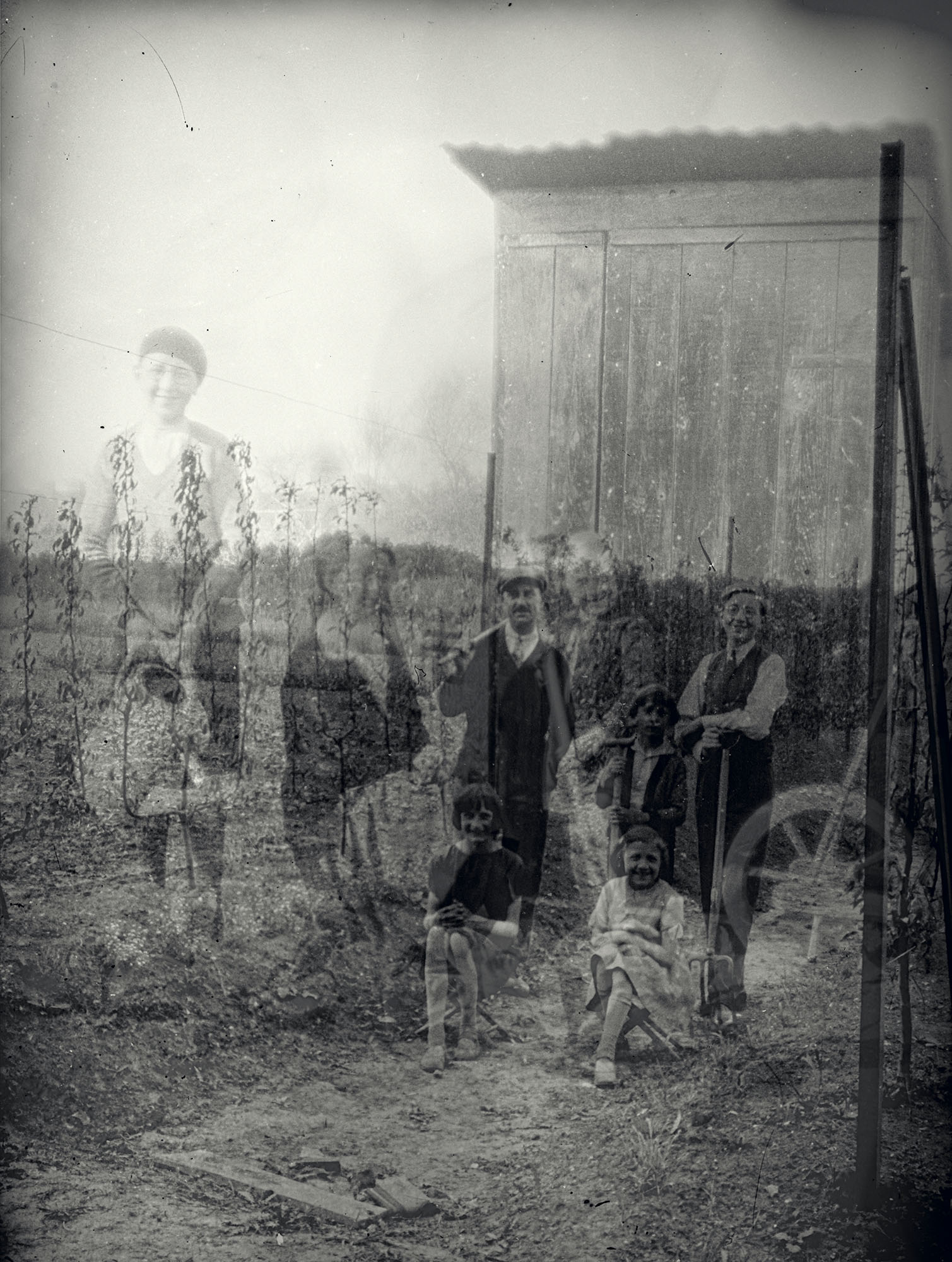
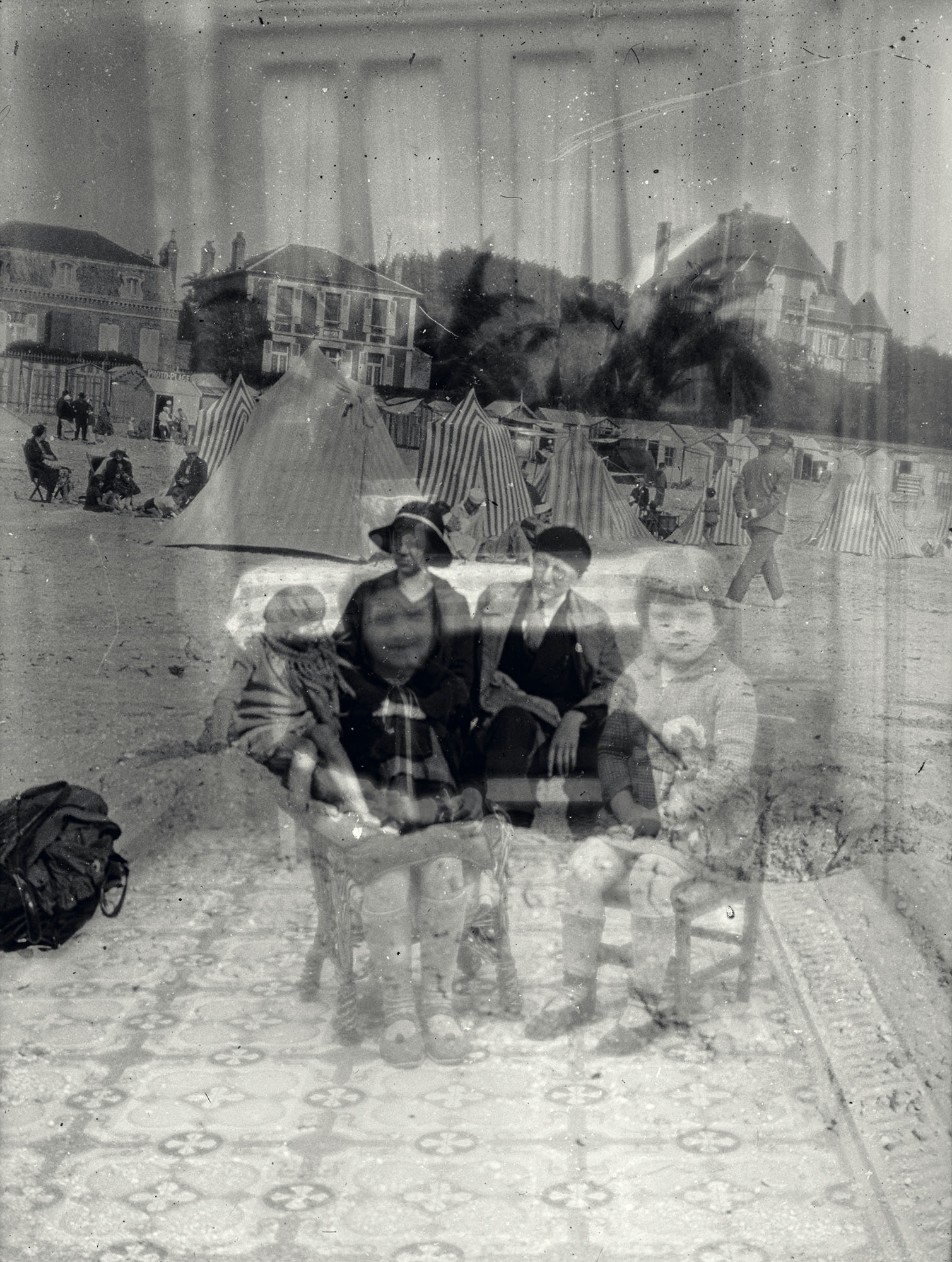
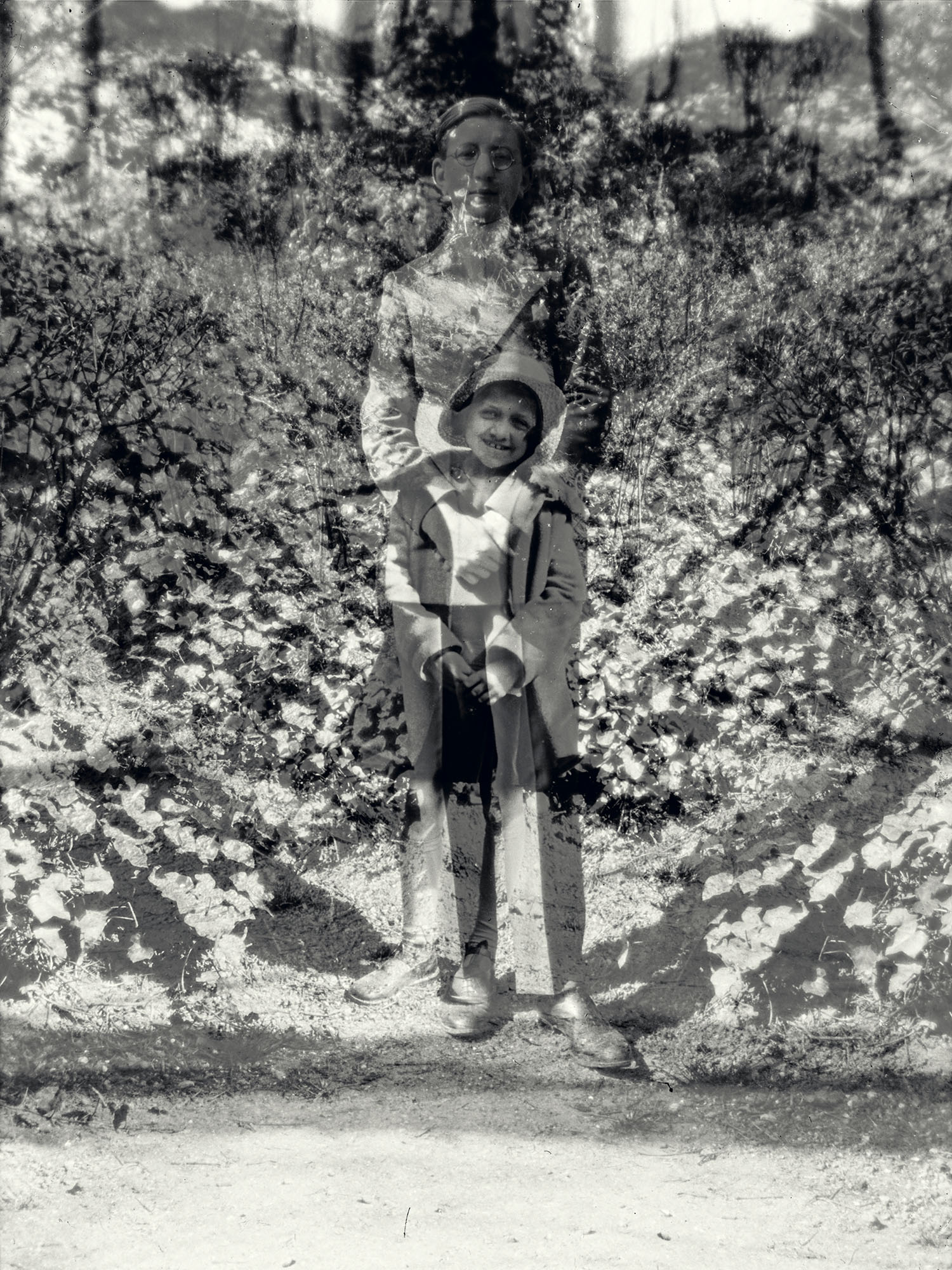
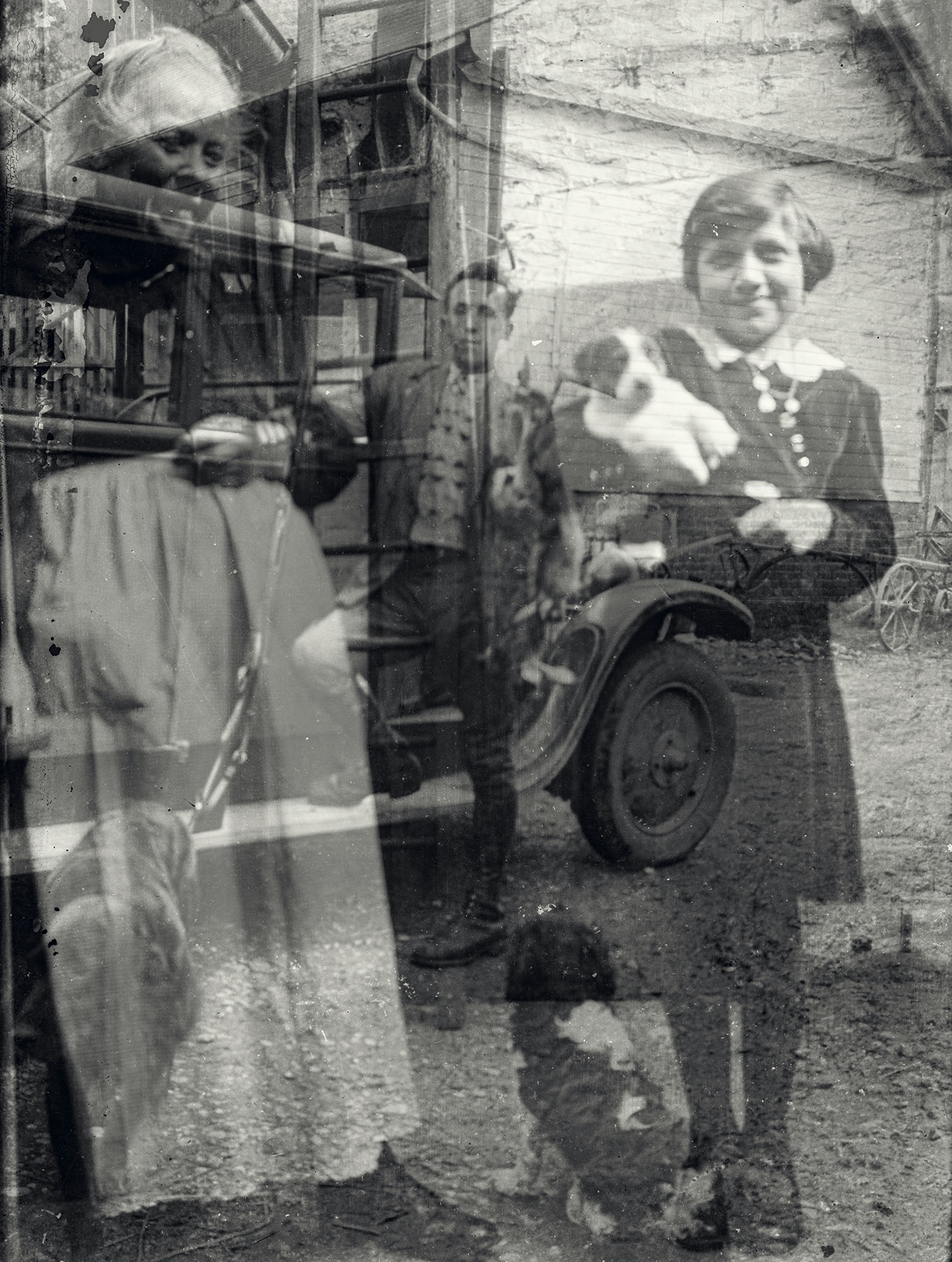
It is within this duality that the series Fondus enchantés takes its place, which Ninni Pepe developed from an accidental event that occurred while viewing the negatives: when two plates stuck together and were held up to the light, an unexpected superimposition appeared, a double exposure which, far from being perceived as an error, was adopted as a method. From an involuntary circumstance a critical device was thus born, capable of redefining the function of the photographic image.
In Pepe’s series, superimposition acts as an instrument of layering and visual amplification: it does not merely multiply signs, but opens up an interpretative field in which memory and imagination are activated simultaneously. In this sense, the negatives lose their function as keepers of memories and become a dynamic, living archive, an unstable system that regenerates itself with every viewing. Representation takes the form of a threshold: a place where past and present, consciousness and desire coexist.
The shift from accident to rule, from chance to method, belongs to a broader trajectory that marks the entire history of photography. Initially conceived as a means of recording reality, photography has progressively called its own testimonial function into question, revealing a more complex vocation. Not only mimesis, but the exploration of new modes of visual experience; not a mere index of reality, but a cultural and symbolic figure, capable of giving form to what escapes ordinary perception.
The historical avant-gardes had already grasped this potential: from Futurism, which celebrated speed and simultaneity in Bragaglia’s chronophotographs, to Rodchenko’s Russian Constructivism, which reinvented the gaze with photomontages and vertiginous framing; from Moholy-Nagy’s Bauhaus, where photography became a laboratory of visual education, to the dreamlike images of Surrealism and the destabilising montages of Dadaism, not forgetting Dziga Vertov’s cinematic research and Man Ray’s visionary experiments. In all these contexts, the technical apparatus proves to be an instrument of revelation, a critical system capable of subverting the conventional logics of representation.
Photography has thus made visible elusive dimensions (dream, the unconscious, illusion), turning them into aesthetic experience through a language capable of translating the unexpected and giving form to the imponderable. This step marks the overcoming of the idea of photography as a simple imitation of reality and opens it up to its cultural and linguistic dimension.
In this direction, techniques of transition and superimposition take on particular importance: not mere tricks, but devices capable of creating intermediate spaces, liminal states of the image. Dissolve, montage by superimposition, double exposure, solarisation, photographic collage: all these processes have helped to redefine the grammar of the visible, allowing photography to escape univocity and to embrace ambiguity. Among these figures, the cross-dissolve (fondu enchaîné) plays a key role: it does not simply serve as a narrative link, but articulates multiple, sedimented temporalities; it does not mark the end of one image and the beginning of another, but stages their coexistence in an intermediate time, in a suspended space that exceeds the linearity of vision.
It is in this logic that Ninni Pepe’s exhibition is entitled Fondus enchantés, turning the French technical term into a meta-commentary: from enchaîné (chained) to enchanté (enchanted). If the fondu enchaîné links two images by binding them together, in Pepe’s series the dissolve becomes enchantment: a suspended moment that restores to the gaze the wonder of an appearing and a simultaneous vanishing.
The superimposition and layering that run through Pepe’s work find a point of comparison in foundational experiences of photography and the visual arts. As early as the second half of the nineteenth century, in the experiments of Oscar Gustave Rejlander (The Two Ways of Life, 1857) and Henry Peach Robinson (Fading Away, 1858), the combination of several negatives was used to build composite narratives, in which time does not stop at the instant but is distributed across several levels. The dialogue with cinema is also fruitful, particularly with Fritz Lang’s tradition of multiplied vision: in Metropolis (1927) the famous transformation of the robot into Maria was achieved with multiple exposures, while the crowd in the Tower of Babel sequence was created with masks that duplicated columns of bodies to form an “impossible” mass. As early as Dr. Mabuse, der Spieler (1922), superimpositions, dissolves and double exposures visualise mental states, hypnosis, ghostly presences and the dissemination of the gaze: the scene doubles, the point of view multiplies, the image loses univocity. Eyes, faces and gestures thicken until they create parallel times. It is the same logic that Pepe’s series adopts as its operating principle, making superimposition an escamotage, a procedure, a form of inquiry that deposits time and space and makes their coexistence visible.
Another line of reflection is the bodily dimension, fragile and unstable, which resonates with other artistic experiences. Francesca Woodman, for example, dissolves the body into space through multiple exposures, making it evanescent, almost on the point of disappearing. In this work by Pepe, faces and bodies become the place where truth and fiction merge: the subject remains poised between permanence and flight.
The coexistence of several scenes on a single surface stages what Gilles Deleuze calls the image-cristal: present and past, real and virtual coexist with no possibility of distinguishing them. The viewer no longer reads the image as a sequence, but as a suspended territory where bodies become transparent, gazes intertwine and stories blur. Family portraits, everyday scenes, urban views and social moments, in which layering not only records presences but anticipates absences. They appear as pages of a family album settling one upon another, as if the series itself were subject to a process of metabolisation. A visual archive not as a static repository, but as an organism that changes, aggregates and produces new forms. An archive that exceeds itself, generating unexpected narratives in which the image, rather than becoming fixed, transforms, expands, multiplies, disperses.
The reflection on temporality also places this work in dialogue with the research of Bill Viola: the temporal dissolves in his works turn the passage from one vision to another into a spiritual experience. Something similar happens in Pepe’s photographs: they do not try to stop time, but to make its duration something that can be experienced. Every superimposition becomes a flow, every epiphany a passage. The superimposition of the negatives generates doubled bodies, transparent faces, interwoven settings. It is no longer possible to distinguish inside from outside, the celebration from the domestic pose, the child from his double: everything merges into a single porous surface, fragile and shifting like memory. These photographs do not fix an instant but hold many, woven into a fabric in which time does not flow but thickens. The figures appear and vanish at the same moment, forcing the gaze to pause, to go back, to search. The result is a pedagogy of slow looking, the opposite of the speed of contemporary images: to see, one must stop, accept ambiguity, inhabit the threshold.
Each superimposition becomes an unfinished story, a condensed dream: children emerging as evanescent presences, families doubling into collective reminiscences, cities, houses and gardens grafted onto faces, poses and gestures. The image does not document but suspends; it does not preserve the past, but transfigures it into a restless, poetic presence.
These are works, then, that do not aim to “document” reality, but to question the tensions between presence and absence, object and depiction, near and far. The combined plates generate a sulphurous iconography of estranging depth: the subjects are present and at the same time distant; deprived of their original function and placed in a new context, they reveal themselves as traces. Photographic multiplication triggers an effect of repetition: the image returns, overlaps, intensifies. Presences thus arise, visible in multiple variations.
In the twentieth century this intuition became poetic practice: the inner landscapes constructed in the darkroom by Jerry Uelsmann, for example, show how photographic superimposition can open a passage into the unconscious.
Pepe’s images seem to inherit these lessons and reinterpret them critically: they do not pursue fantastic illusion, but question the stability of the gaze, leading it towards what manifests itself as double, trace, latency. Rather than fixing an instant, photography accumulates duration, turning from a static object into a temporal experience. This aspect becomes the true centre of this work: each image extends, transfigures and stages time. It is a body of work that subverts the idea of photography as document, also because each viewing carries with it, in addition to the author’s intention, the analogue unpredictability of the glass plates. The layered images become exercises: attempts to cross and rework the distance between the real subject and its projection, between what is seen and what is inevitably lost.
Ninni Pepe’s series Fondus enchantés brings out a poetics that develops along intertwined lines: the portrait as a field of tension between subject and author, seriality as an instrument of memory and comparison, and technique as a critical extension of thought. Superimposition, generated by the plates sticking together, becomes for Pepe an operating principle that recalls the Freudian processes of condensation and displacement, producing works that are not additive but transformative, in which memory, dream, desire, imagination and presence merge into an unstable and complex visual syntax. From this perspective, his research resonates with the work of Diane Arbus, who through her portraits revealed the fragility and dignity of marginal subjects, turning the photographic act into a gesture that is both critical and ethical. In Pepe too, the image does not merely record, but calls on the viewer to come to terms with the ambiguity of presence and the precariousness of time, rescuing fragments of existence from oblivion.