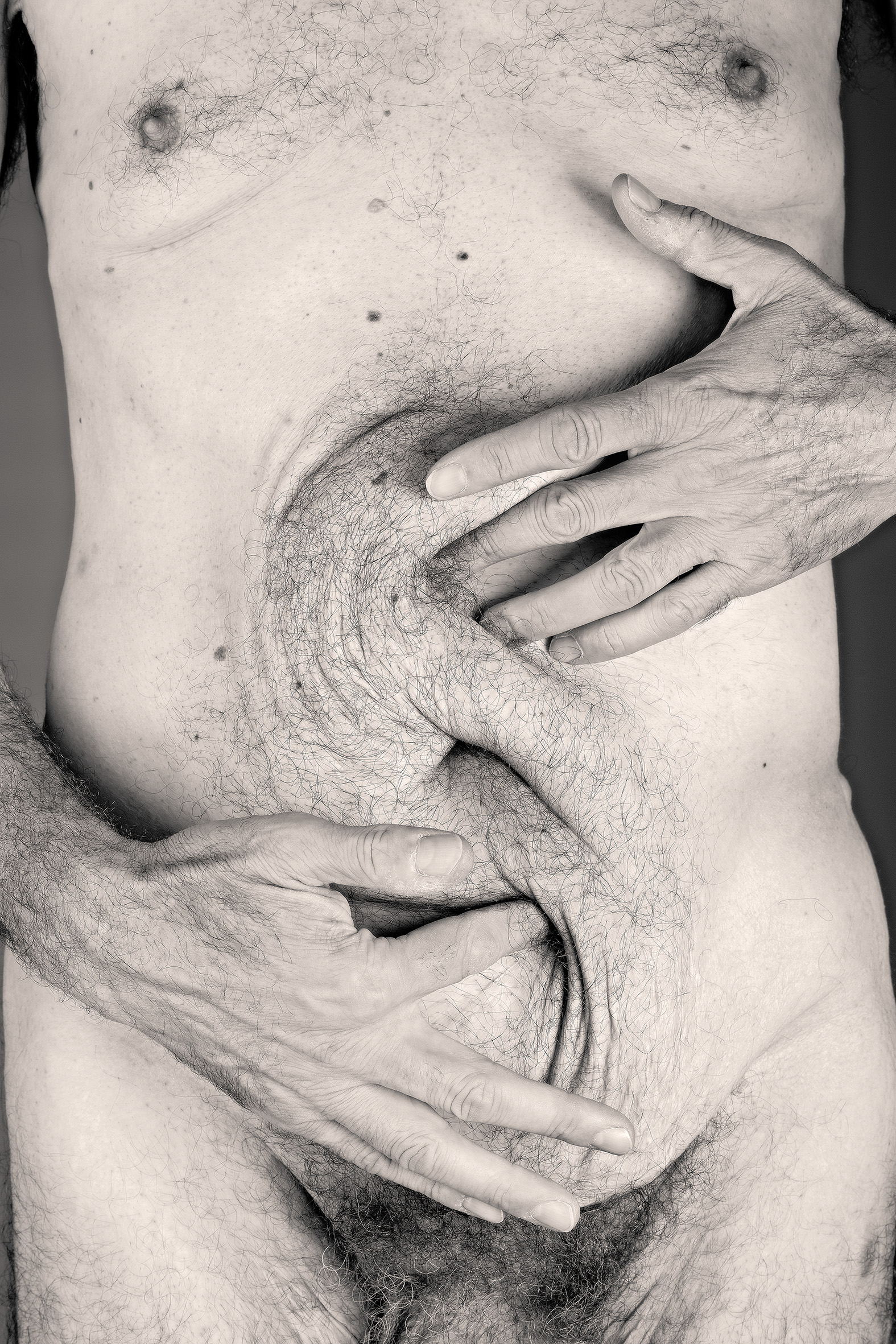
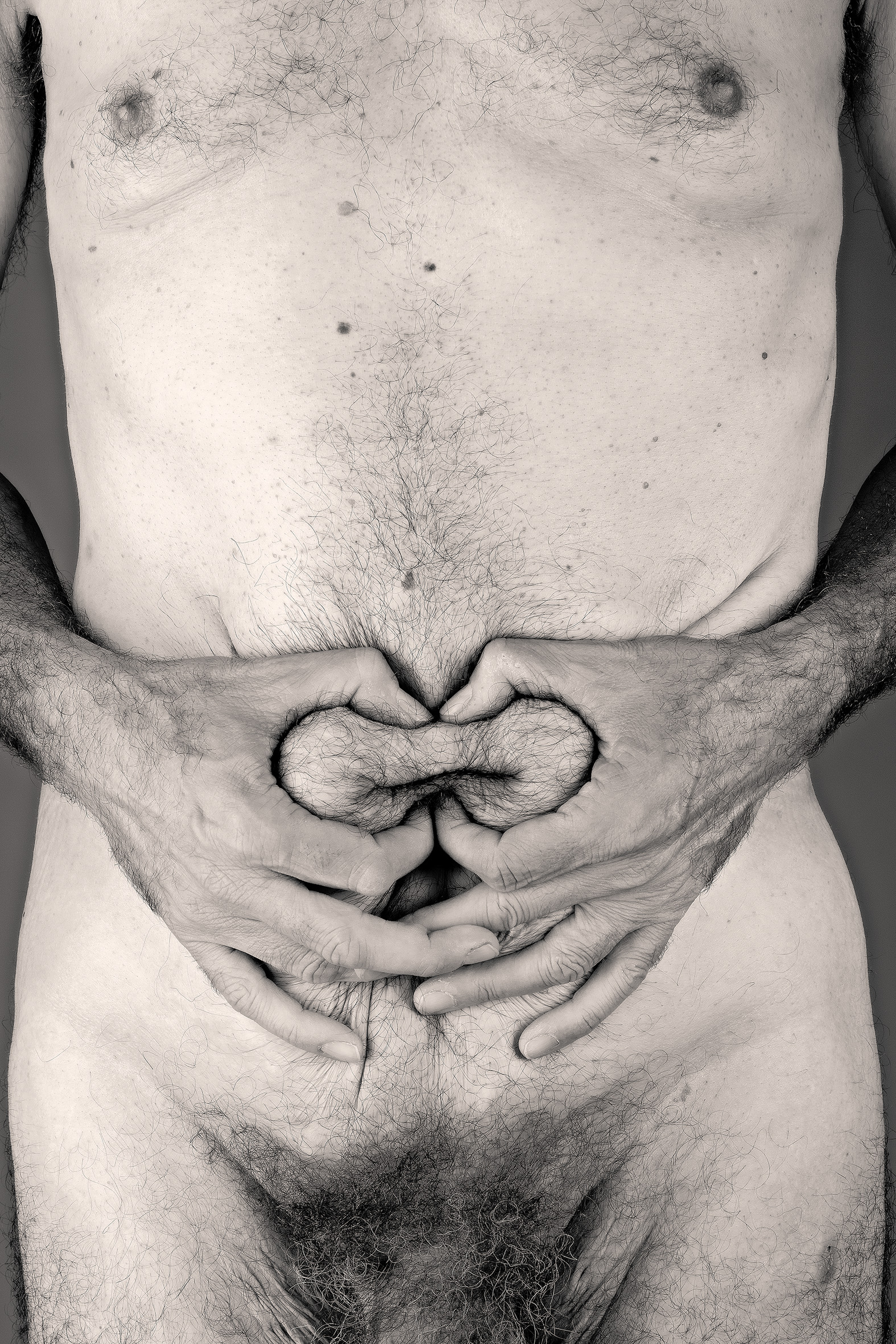
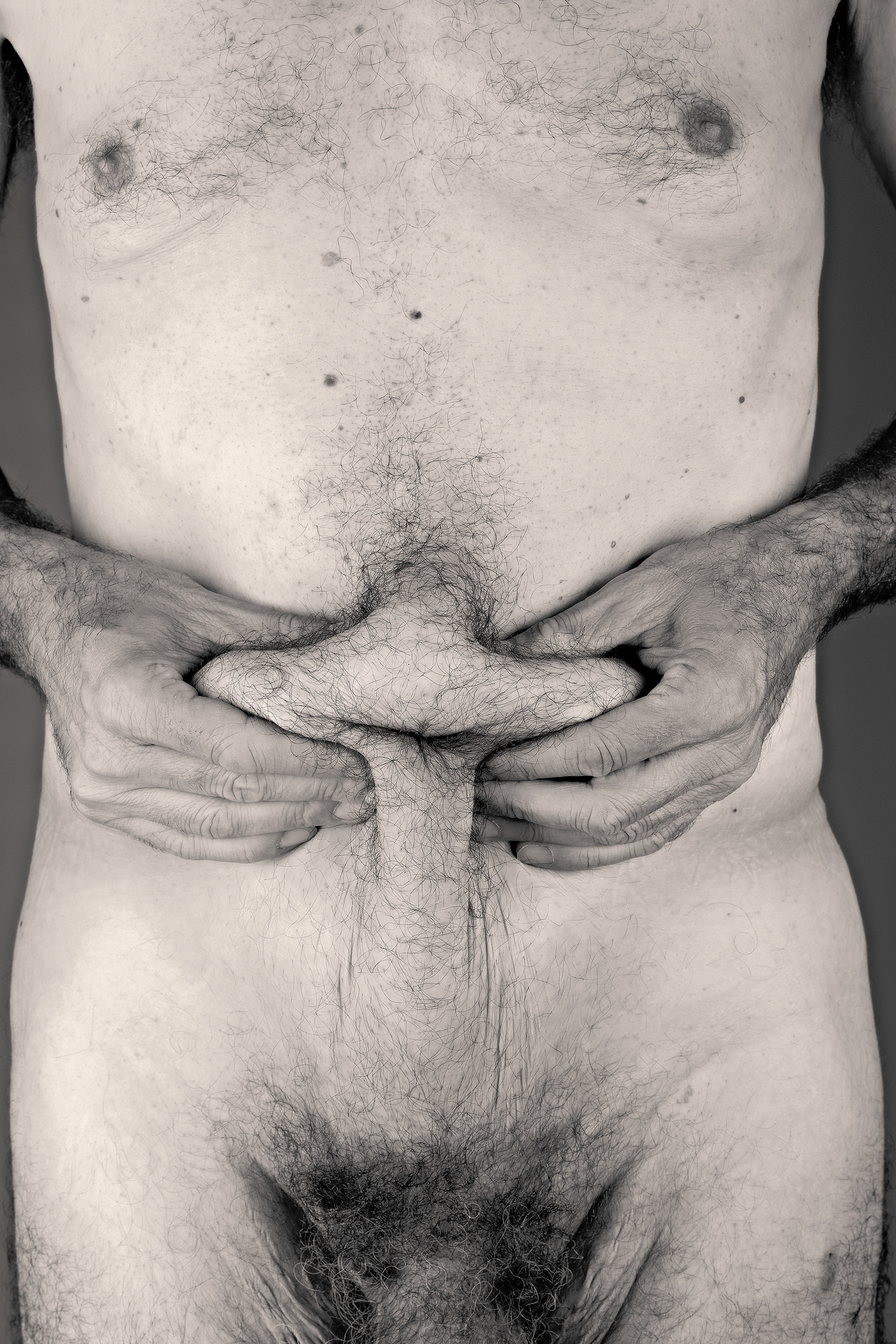
When the artist’s inspiration involves body and mind in the experience as well as in the expression of feeling, the work becomes instinct and passion, forming a single whole with its surroundings. The creative formula is simple and effective: the idea turns into gesture and the gesture becomes image, so that the artistic message can spread beyond the limits of the hic et nunc of intuition. In a nutshell, this is the “mechanism” of performance, which the series The form’s machine by Nini Pepe seems to draw on, calling into play some key concepts of this extraordinary art form, which in the 1960s revolutionised the ways in which art is experienced and understood.
I am referring in particular to the use of the body as the vehicle and object of the performative action, and to the presence of a medium such as photography, which spreads and communicates artistic content through widely reproducible images. From the very first glance at this project, it is clear that Nini Pepe places at the centre of his vision the relationship between the representation of the body, the self-portrait and photography, regarding the latter as the instrument that records his thought and becomes its spokesperson. Through this highly personal creative process, his series develops through slight formal variations on a single subject, and takes shape on the set of a representation conceived and constructed around himself. And so the physical centre of his body (rising from the lower abdomen to the chest) hosts “chaos”, the “heart”, the “cross” and “infinity”, among the elements that the author mimes and describes with his own hands and his own belly, giving them new form and meaning. It is as if irony, play and imagination were staging the author’s most intimate loves and obsessions, those abstract concepts that fascinate and captivate him so much that he is led to create their symbolic representation, in the first person, with a highly realistic and concise photographic style. Everything is thus resolved on the body and through the body, while nudity makes the inspiring idea even clearer, purifying it of possible contamination and aesthetic interference. In this way the feelings of the man and of the artist are expressed in the performance, without filters or mediation, while the camera records its image with the precision of a crisp black and white.
In the light of these considerations, my gaze grows sharper and, looking again at the flowing rhythm and formal coherence of this photographic series, I immediately have the sensation of entering a parallel universe where art, life and photography intersect. This is why I find Nini Pepe’s series interesting. With complete generosity and naturalness, it manages to bring to mind one of the most interesting moments in contemporary photography, when it entered into dialogue with the American avant-gardes of the 1960s. At that time, while art performance (within movements and practices such as Fluxus, Body Art and happenings) made possible a linguistic and structural revolution in the art world, photography was becoming more aware of itself, upholding and reaffirming the centrality of the author. From then on, the silver gelatin image took on a new role: it broke free entirely from the definition of a mechanical tool aimed at the faithful reproduction of reality, and opened up to conceptual art, to contamination and to the centrality of the point of view. In that period John Szarkowski (Director of the Department of Photography at MoMA in New York) also recognised the photographer as an artist and intellectual and, in “The photographer’s eye” (still regarded today as a key text in the history of photography), wrote that the photographer’s gaze could reach far beyond the bare facts of reality, in search of “the image hidden in reality”.
The form’s machine by Nini Pepe reflects on themes and subjects which, starting from an intimate and personal experience, have touched the chords of photographic language at the heart of its evolution towards a new artistic awareness. In this intimate representation of his body, the author has created a series of great interest, capable of expressing itself on several levels of language and meaning.
Denis Curti
A recent book on Mapplethorpe’s life, art and eroticism bears the subtitle ‘Photography at Gunpoint’.
English speakers use the same verb for firing a gun and taking a photo: to shoot.
Most people who make photographic images, often with a smartphone, believe that photography immortalises its subjects. That is why, on social networks, people post the places, people, food and objects they encounter in the course of their lives, almost as if seeking certification of their lives in the captured image.
Personally, I have always thought the opposite: that photography kills. The instant a shutter opens to let light strike a sensitive surface, a timer starts and reality detaches itself from its photographic representation, imperceptibly but inexorably.
In a photo we can observe an image that is falling away, already dead. Just as the light of a distant star, reaching us after thousands of years, may show us something that no longer exists.
Photography is therefore violent, like the world we live in.
I have always wondered why man, unlike animals, is capable of gratuitous violence, violence not justified by usefulness or profit. Perhaps the executioner rages against the victim as a kind of exorcism: if I am the executioner I am not the victim, and the more I am the executioner, the less I am the victim.
And so photography can be an exorcism in every sense…
When we turn violence on ourselves (suicide or the self-portrait), can we still speak of exorcism? A scapegoat is always something other than ourselves.
Suicide interrupts the course of time, while the self-portrait turns our body into a more attractive corpse than the one it will soon actually be. So yes, at least for self-portraits the exorcism still works, and we can delude ourselves.
When, however, self-portraits concern an advanced age like mine, the operation is less successful, and beyond a veil of illusion one senses a kind of punishment, a touch of masochism.
Look at the image of a human torso, without arms or head.
Doesn’t it look like a caricatured face, a sort of cartoon or an emoticon?
All it seems to lack is speech, not least because in place of the mouth there is a belly..
It has recently been shown that the gut is a genuine second brain, closely connected to the first, capable of producing serotonin, a neurotransmitter that regulates mood, sleep and abdominal contractions.
There appears to be a real gut-head axis:
it is not only the brain that acts on the gut, through the somatisation of emotions; intestinal problems also seem to influence the brain and our mood…
In this series of photos I have tried to give the belly the chance to communicate, not with sounds or words, but with conventional signs…
I felt I could glimpse in these images a summary of Peirce’s semiotics, so widely used and abused from the 1980s onwards to frame the phenomenon of photography (and, according to Rosalind Krauss, much contemporary art too) in its indexical nature, as a trace of the real through direct contact…
Looking closely, we can recognise iconic signs, resembling reality (the torso standing for the face); symbolic signs, by conventional association, in the abstract shapes made with the hands; and indexical signs, by